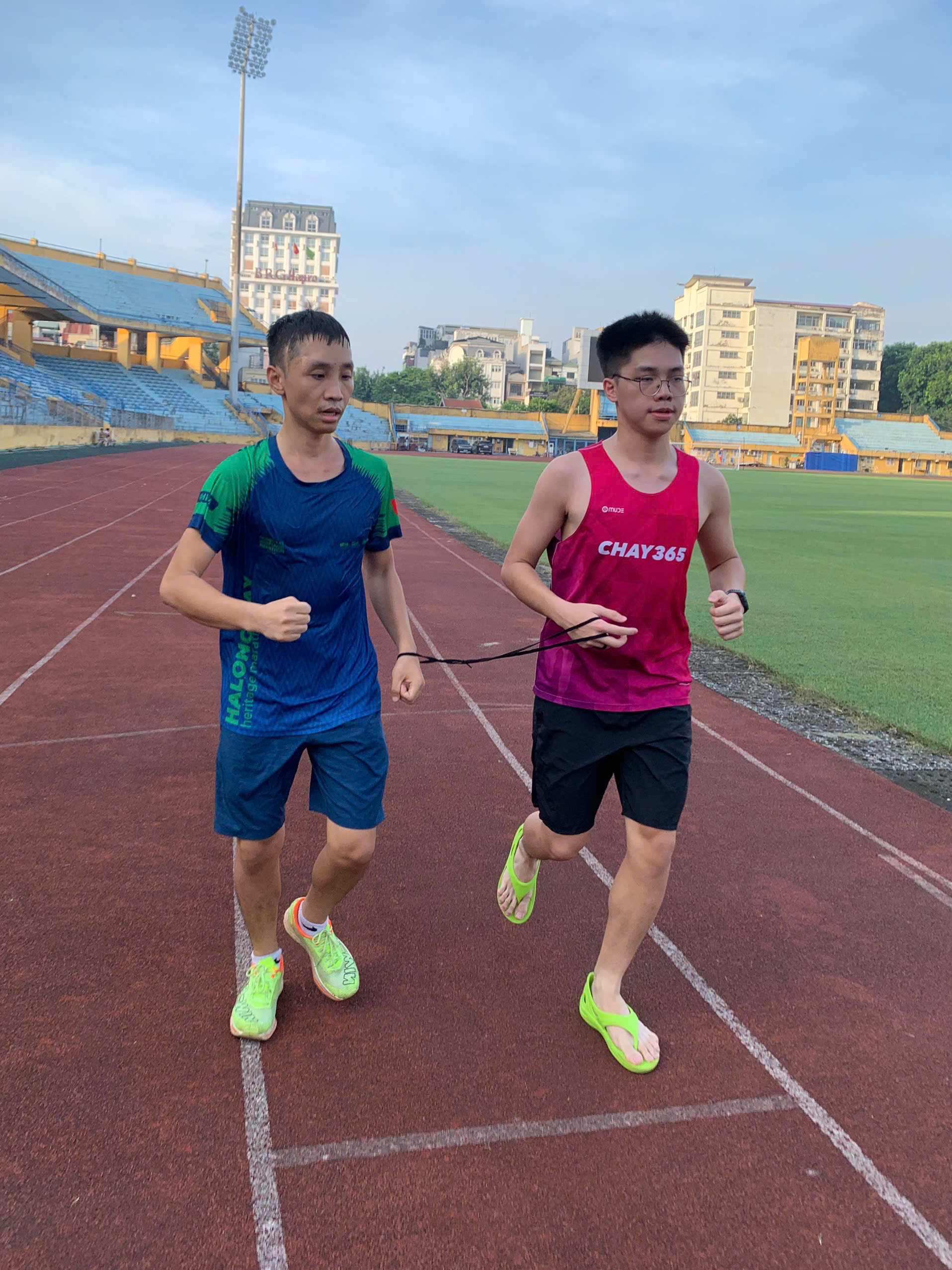
The first glimmer of sunshine was barely over the horizon, weakly illuminating Hang Day Stadium and not yet strong enough to shoo away the morning fog. It hadn’t rained the night before—thankfully—but the air held the damp, bone-clinging cold of a Hanoi winter. Outside the stadium walls, the faint roars of early morning motorcycles drifted through the fog, carrying wet-market vendors and shopkeepers into another busy day.
I slowed from a light jog, catching my breath, and glanced across the field to the opposite gate. Having arrived early, I’d taken the chance to test out the stadium’s battle-worn track with a few warm-up laps. And that’s when I saw them: figures approaching, some holding white canes in various colors. Even from a distance, I could hear their conversations—bright, animated—and the occasional burst of laughter cutting clean through the cold.
And just like that, it clicked.
I had been pondering the thought for days, turning it over in my head, but only now—seeing this group of blind runners approaching the track—did it really hit me: this is something special. Something I’ve never experienced before.
How is it possible to be a blind runner?
A few nights ago, I had stumbled upon a post online. The image seemed ordinary at first: two runners in their 20s, beaming at the camera, standing on a track in bright running singlets and Nike Vaporflys. Another feel-good running photo—until I looked again.
The woman’s eyes were a pale, cloudy white, unfocused and slightly off-center. The man beside her had one eye partially open, the other completely shut.
I blinked.
Then I saw the caption: Vietnam Blind Runners Club.
And now, here I was. Standing in the middle of their group.
“Hi! My name is Huy!”
“Hi Huy! Wow, you are tall!”
I froze. Wait—someone had said my name, but… no one was looking at me.
Right.
Of course.
I smiled awkwardly. My pause was rapidly stretching into awkward silence.
“Uhh—sorry, where are you?”
A hand to my left shot up. “Here!”
I turned and met my partner for the day: about a head shorter than me, wearing a “VPBank Marathon 2024” shirt and an eye-searing orange pair of Nike trainers. His eyes were misaligned, not quite focused on anything, and wandered slightly as he spoke.
“My name is Mạnh,” he said softly, voice calm, almost serene. “Are you my guide runner today?”
“Yes! Also, how did you know my height if you… well, you know?”
He chuckled while bending down to adjust his shoes. “When you’ve had one less sense for a while, you get really good at using the rest.”
We finished warming up, and he followed the sound of my voice as we walked out onto the track. The fog had begun to lift. The first real light of the morning stretched across the sky in pale gold.
“So, we’ll hold this rope as we run, right?” I asked, taking the simple tether between us.
“Yep. If you want me to go left or right, just give it a little pull.”
Sounded simple enough. Let’s hope I don’t mess this up.
We started off with two slow, easy laps. Like any runners, we began chatting as soon as our watches beeped.
“So, how long have you been running?” I asked.
“Just started a few months ago. Wanted to lose a few pounds, you know? What about you?”
“A few years now! My parents got into it first and dragged me along. At first I hated it. But now—oh, first bend coming!”
I panicked a little, wondering how much force to apply to the rope. Not too much, not too little…
“I know,” Mạnh said smoothly, sensing my hesitation. “Just turn left naturally.”
I adjusted my stride. The rope between us grew taut for a second, and then we curved together around the bend. Effortless. Fluid. Like we’d been doing this for weeks.
“So… you’ve memorized the whole track?” I asked, incredulous.
“Almost! Still working on remembering all the little bumps and tears.”
The back of my mind kept asking the same thing: how?
I thought back to my own running experiences—the full marathon, the half, the pain, the exhaustion, the mental fog that hit like a wall. I’d felt helpless at times, barely dragging myself forward.
Running, as natural as it might be to humans, is still hard. And yet here was someone doing it without sight—without the very sense I depend on the most to get through a race. How could he do it?
I slowed slightly, took a breath, and closed my eyes.
Instant panic.
Every instinct in my body screamed at me to stop, to open my eyes, to see. The loss of control was immediate, like stepping off a ledge in the dark.
Mạnh chuckled softly. “Trying to run with your eyes closed?”
I opened my mouth in surprise.
“And now you’re looking at me,” he added. “Trust me—when you lose sight, your other senses become very, very good.”
We ran about 5 kilometers at a relaxed pace, chatting in bursts. I learned that Mạnh lost his sight over a decade ago, the result of a traffic accident. Like many visually impaired people in Vietnam, he works as a masseur. On good days, he might make a few hundred thousand VND.
But more than the facts, what stayed with me was the way he talked. Calm. Measured. Unshaken. There was no self-pity. No dramatics. Just a quiet, consistent forward motion—in running, and in life.
I asked him, gently, how he lives with the idea of never seeing again.
He shrugged, like it wasn’t even a question. “You just have to keep moving.”
When the run ended, I unclipped the rope from my wrist, but a part of me still felt tethered.
There’s a quote from Lex Gillette, a blind American Paralympian: “Who needs sight when you have vision?”
And now I get it.
Because what I saw today wasn’t just strength or determination. It was a kind of peace. A radical form of trust—not just in your guide runner, but in the world, in yourself, in the belief that forward is still possible, even when everything ahead of you is dark.
It’s something I don’t fully understand. I don’t think I ever will.
But I do know this: that morning, in the cold Hanoi air, I saw more from the blind than I ever expected to. And I’ll carry that with me for a long time.
Leave a Reply